Leads · Guide
How to Ask for Referrals From Happy Customers
Quick answer
Ask for referrals shortly after a service is successfully completed while the customer is still happy. Use a polite automated email sequence that provides a direct link and a clear, simple request.
Asking for referrals is one of the most reliable ways to grow a service business, yet many owners put it off because it feels awkward or difficult to time correctly. When you leave word-of-mouth growth to chance, you miss out on a steady stream of warm leads who already trust your work.
By building a simple, repeatable process for asking happy customers to spread the word, you turn your current client base into your best marketing channel. This guide covers how to time your requests, what to say, and how to automate the follow-up so you never have to remember to do it manually.
Find the right moment to ask
Timing is everything when it comes to referral requests. If you ask too early before the client has experienced the result of your service, they will feel unready. If you ask too late, the initial excitement of working with you fades and they move on to other priorities.
The best time to ask is right after a successful outcome has been delivered. For a clinic, this is right after a successful treatment plan or positive check-up. For a salon, it is as the client leaves with their fresh haircut. For a home service trade, it is the moment the job is finished and the customer inspects the work. You can also pair this with strategies mentioned in How to Get More Google Reviews Automatically (Without Being Annoying) to capture feedback and referrals at the same time.
Keep the window tight. Aim to send your referral invitation within twenty-four hours of completing the job. This ensures your service is still fresh in their mind and their positive feelings are at their peak.
Keep your message short and clear
Your customers are busy people. If you send them a long, complicated email explaining referral tiers, codes, and terms and conditions, they will simply delete it. Your ask needs to be clear, direct, and respectful of their time.
Focus the message entirely on how easy it is for their friend to get help. Do not make it sound like you are desperate for business. Instead, frame it as an invitation for them to share a trusted resource with someone who might be struggling with the same problem they just solved.
A good referral message should fit on a phone screen without requiring scrolling. It should state what you do, thank them for their recent business, and give them a single link or button to forward to a friend.
Write a warm referral request email
Writing from scratch every time takes too much time. Instead, use a friendly template that you can reuse or automate. Here is an example you can adapt for your own service business:
Subject: Quick question about your recent visit, [First Name]
Hi [First Name],
It was a pleasure helping you with [service/project] this week. I hope everything is working out well for you.
We love working with people like you. If you know any friends, family members, or colleagues who might need help with [core service], we would love to take care of them.
You can simply forward this email to them or send them to this link: [Link]
Thanks again for choosing us,
[Your Name]
You can pair this kind of communication with the approach found in how to follow up with leads automatically to ensure your outreach remains consistent across all customer touchpoints.
Send a single gentle reminder
Even if a customer loves your work, they might open your referral email while waiting in line at the grocery store, intend to reply later, and then completely forget about it. That does not mean they do not want to help; it just means life got in the way.
A single gentle follow-up email a few days later often doubles your response rate. Keep it even shorter than the first note. Acknowledge that they are busy and reiterate the simple link.
Here is a simple follow-up template:
Subject: Re: Quick question about your recent visit
Hi [First Name],
Just floating this to the top of your inbox in case it got buried. If anyone comes to mind who needs help with [core service], our door is always open.
Hope you have a great rest of your week,
[Your Name]
Make it rewarding for both sides
While some customers will refer you purely out of goodwill, offering a small incentive gives them an extra reason to act. The key is to make it valuable for both the existing customer and their referred friend.
For service businesses, reciprocal incentives work best. You might offer a discount on their next appointment for the referrer, and a welcome discount for the new client. Keep the structure simple so there is no confusion about how it works.
Here is a quick comparison of different referral incentive styles for small service businesses:
| Incentive Type | Best For | Complexity |
|---|---|---|
| Direct service discount | Salons and clinics | Very low |
| Free add-on upgrade | Trades and home services | Low |
| Cash commission | Agencies and B2B | Medium |
The workflow, step by step
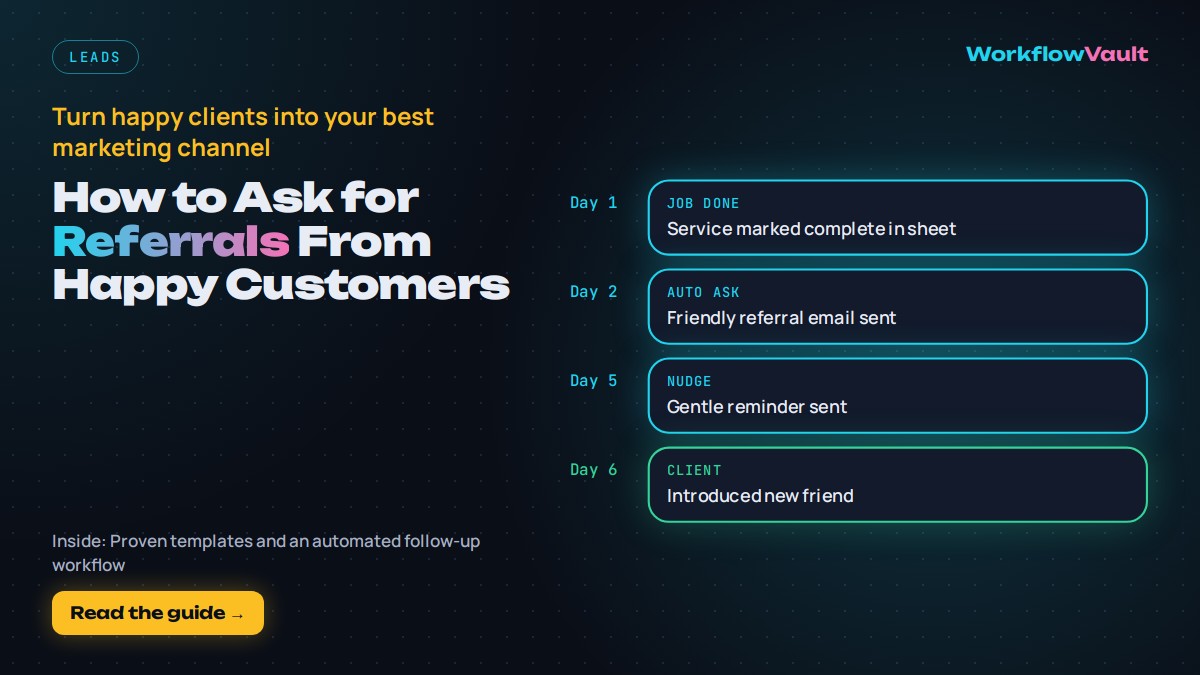
- Mark a job or appointment as completed inside your Google Sheet or booking tracker.
- Trigger an automated workflow that waits for a set delay, such as twenty-four hours.
- Send a personalized referral request email using Gmail or your preferred email tool.
- Wait for a few days to see if the customer interacts or forwards the link.
- Send one gentle follow-up reminder email if no referral has been logged yet.
- Log the referral status in your tracking sheet so you know who to thank.
Common mistakes to avoid
Avoid asking for referrals before you have actually delivered value. If a customer had a bumpy experience or an unresolved issue, asking them to recommend you will damage your reputation.
Do not spam your clients with endless requests. Stick to an initial ask and one gentle reminder. If they do not respond, let it go gracefully.
Never make the referral process complicated. If a customer has to fill out a long web form, create an account, or jump through hoops to introduce someone to you, they will abandon the process.
Start growing through word of mouth
Getting more word-of-mouth clients does not require complicated marketing campaigns or expensive ads. By setting up a reliable system to ask happy customers at the right moment, you make it easy for your advocates to spread the word. Use our Review Request Follow-up template to automate this entire process and turn finished jobs into a steady stream of new leads.
Frequently asked questions
When is the best time to ask for a referral?
The best time is right after you have successfully completed a service and the customer has experienced a positive result, ideally within twenty-four hours.
How many referral emails should I send?
Send an initial request and one gentle follow-up reminder a few days later if they have not responded.
Should I offer a reward for referrals?
Yes, offering a small discount or a free add-on for both the referrer and the new client encourages higher participation rates.
What if the customer does not respond?
If they do not respond to your follow-up reminder, let it go gracefully and try again after their next successful service.
Templates for this job
Want it built around your exact tools? Custom n8n workflows from $150.