Leads · Guide
How to Write Cold Emails to Local Businesses That Get Replies
Quick answer
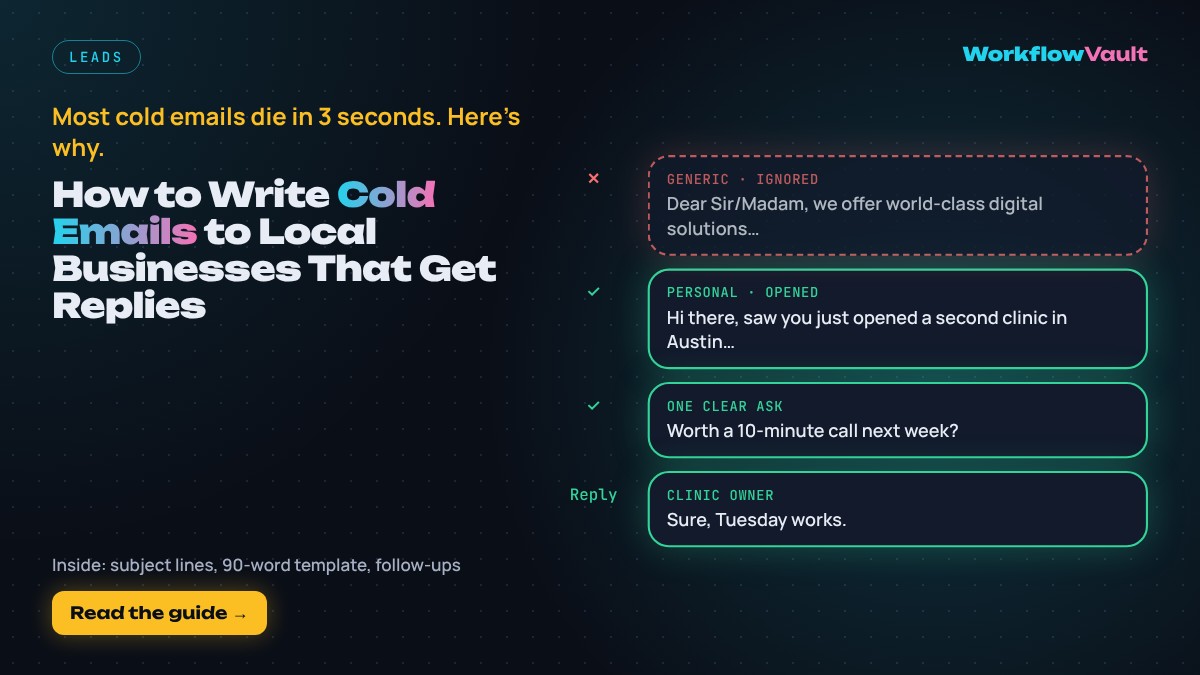
Keep it under about 100 words: a subject about their benefit, one true detail about their business in the first line, one problem you solve in plain words, one small proof, and an easy yes-or-no question. Send to a short list, follow up once or twice, and stop as soon as they reply or say no.
Local business owners are busy people who get a lot of sales emails. Most of those emails are long, generic and about the sender. The ones that get replies are the opposite: short, clearly written for that one business, and easy to answer.
This guide gives you a structure you can reuse for any niche, with examples, plus the follow-up rules that keep you polite.
The five-part structure
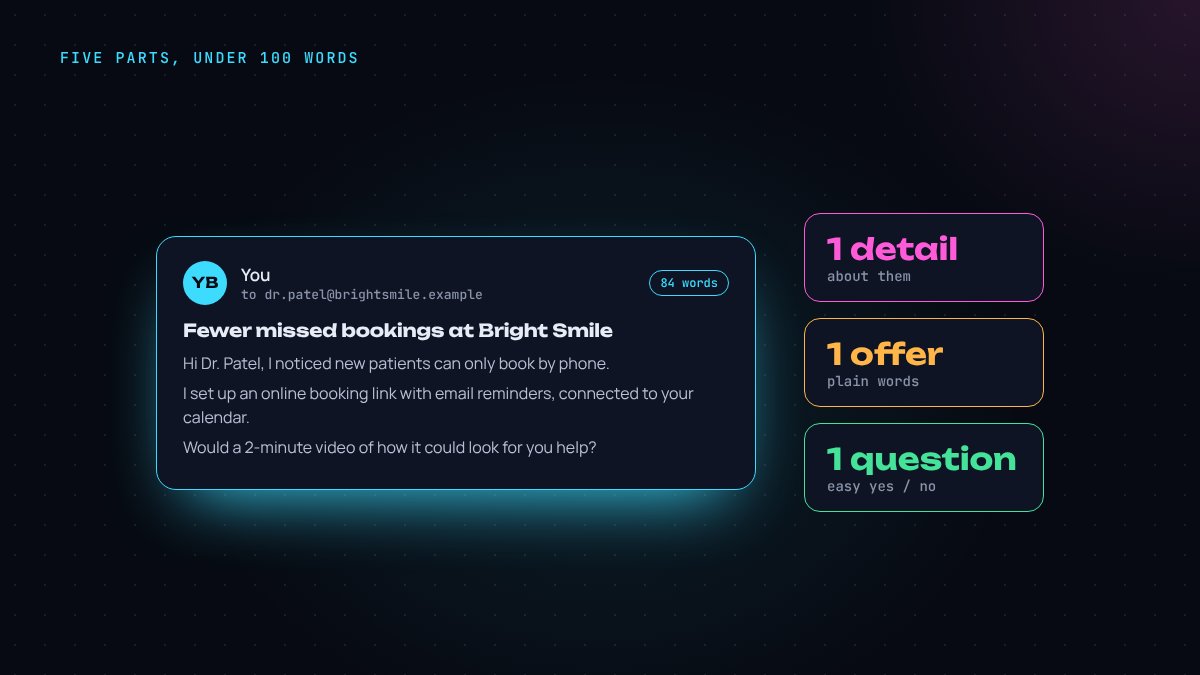
- Subject: about their benefit, in a few plain words.
- First line: one true, specific detail about their business.
- The problem: one thing that costs them time or money, in their words.
- The offer and proof: what you do about it, with one small piece of evidence.
- An easy question: something they can answer with "yes" or "no".
That fits in 60 to 100 words. If your email needs scrolling on a phone, it is too long.
Subject lines
The subject has one job: get the email opened without feeling like a trick. Write it about what they get, not about you, and keep it short.
- Good: "Fewer no-shows at Bright Smile", "Quicker replies to new patients", "Booking online after hours"
- Weak: "Bright Smile Dental" (just their name), "Quick question" (vague), "RE: our call" (a lie)
Never fake a reply or a forward. It may get an open, but it kills trust before the first line.
The first line is where personal happens
Use something you actually saw: "I noticed new patients can only book by phone on your site", "Saw you opened a second clinic on King Street", "Your reviews keep mentioning how friendly the front desk is". One detail is enough. It proves a person looked, and it leads naturally into the problem.
Avoid fake compliments ("I love your website!") and anything you cannot back up.
One problem, one offer
Pick the single problem most relevant to what you noticed. Describe it the way the owner would: "missed calls when the front desk is busy" is better than "suboptimal lead capture". Then say in one sentence what you do: "I set up automatic email reminders and an online booking link, so fewer patients forget and new ones can book at night."
Proof can be small and honest: a similar business you helped, a short demo, or a free sample. Do not invent numbers.
End with an easy question
"Would it be useful if I sent a 2-minute video of how it would look for you?" is easy to answer. "Are you free for a 30-minute call next Tuesday at 3?" is a big ask from a stranger. Make the first yes small.
A full example
| Part | Text |
|---|---|
| Subject | Fewer missed bookings at Bright Smile |
| Body | Hi Dr. Patel, I noticed new patients can only book Bright Smile by phone. Clinics I work with lose a few bookings every week when the line is busy or it's after hours. I set up a simple online booking link with automatic email reminders, connected to the calendar you already use. Would a 2-minute video of how it could work for you be helpful? Sam, [your business] [your business address] Not relevant? Reply "no" and I won't email again. |
First lines and offers by niche
Use these as starting points. Swap in a detail you actually saw on their site.
| Niche | Detail to look for | Problem to name | Small offer |
|---|---|---|---|
| Dental and medical clinics | Booking by phone only | Missed calls and no-shows | Automatic appointment reminders |
| Salons and spas | No online booking or reviews link | Empty slots, few new reviews | Booking link plus review requests |
| Agencies and freelancers | Contact form with no instant reply | Leads going cold overnight | Instant AI lead replies |
| Trades (plumbers, electricians) | Quote request form | Slow quotes, unpaid invoices | Polite invoice reminders |
| Online shops | No order follow-up | No repeat buyers or reviews | Post-purchase follow-up emails |
Five subject lines you can adapt
- "Fewer no-shows at [business]"
- "Booking online after hours at [business]"
- "Faster replies to new [patients/clients]"
- "Getting paid on time at [business]"
- "More Google reviews for [business]"
Follow-ups without being annoying
- One or two follow-ups, a few days apart, are normal. More than that rarely helps.
- Add something new each time (a short example, a different benefit) rather than "just bumping this".
- Stop immediately when they reply, book, or say no.
- Same thread, so they see the context.
The basics that keep you safe
Rules for business email differ by country, so check the ones that apply to you. Good practice everywhere: use your real name and business, include your business address, give an easy way to opt out, honour it straight away, send from your own domain and keep volumes small. Sending a few personal emails a day protects your domain's reputation far better than a big blast.
Using AI to draft, not to send
AI is good at turning a detail from a website into a natural first line and keeping every email short. It is not good at knowing when it is wrong. The safest setup is AI drafts, a human reads and sends. That is how our lead hunting workflow works: it reads each business's website, writes a 60 to 95 word draft with one true detail, and saves it to a sheet for you to review.
Ready-made template
AI Local Lead Hunter
Finds local businesses in your niche, reads their websites, scores the fit and drafts a short personal first email for each, following the structure in this guide. Nothing is sent without you.
Need prospects to email first? Read how to find local business leads for free. When replies start coming in, qualifying them with AI helps you answer the hot ones first.
Frequently asked questions
How long should a cold email be?
Short enough to read on a phone without scrolling, usually 60 to 100 words.
What is a good cold email subject line?
A few plain words about the benefit to them, such as 'Fewer missed bookings at [business]'. Avoid fake 'RE:' subjects and vague 'Quick question' lines.
How many follow-ups should I send?
One or two, a few days apart, each adding something new. Stop as soon as they reply or say no.
Should AI send cold emails automatically?
It is safer to let AI draft and a person review and send. That catches mistakes and keeps every email genuinely personal.
Templates for this job
Want it built around your exact tools? Custom n8n workflows from $150.